Supermarket blog
Paadmaan projects, Tehran, Iran

Choreophobia, Lilian Nejatpour, performed by Eva Escrich González and Lauren Stewart, curated by Nora-Swantje Almes and Lorén Elhili, Somerset House, Chisenhale Studios and Edinburgh Fringe Festival, (2018), photo: Dimitri Djuric
Title of Project: Return
Project Implementer: Paadmaan projects
Project Researcher: Foad Alijani
Project Description: ‘Return’ is Paadmaan’s research-based project which seeks to explore method and perception in documentation of site-specific and time-based art projects (e.g. installation, performance, new media). This involves compiling artists interviews in addition to the research into a book and curatorial research exhibition [the project focus is Iranian artists].
Here is part of an interview with Lilian Nejatpour – Iranian artist based in London.
- I’d like to begin with an introductory question regarding documentation within your practice before transitioning into your works specifically. At what point did documenting your art gain significance for you as a representation in itself beyond the initial or physical encounter?
So, I think the film becomes its own art object. I think sometimes when you document a performance it is quite difficult to capture the liveness and body moving in the space. It becomes its own artwork and in a sense, its own art object. I think it is difficult to represent performance through a film. My work is very much about the experience of being there, feeling the music – the bass, and the vibrations. Also, seeing the bodies move with one another, I think sometimes it’s harder to capture this through film documentation.
- What’s your experience in documenting?
I worked on the documentation of a recent performance entitled ‘Choreophobia’. The performance looks at Middle Eastern dance practices, and extracts movement from private gatherings, exploring how men move within private and public spaces. I’m trying to create a documentary at the moment, which talks about this research and looks at how western audiences viewed these performances and deemed their gestures as effeminate. Western audiences would automatically try to assign a gender to their actions. I guess there is a lot of limitation of dance in Iran now as a result, especially through its current criminalisation. In the documentary ‘Choreophobia’, I corroborate this research, looking at the history of male dance. I guess writers that I’ve looked at include Anthony Shay and Homi K. Bhabha, who talk about the dislocation of culture and what it means for a British-Iranian artist to occupy ideas of the ‘third space’, which combines this Western and Eastern duality. So, it’s all about this cultural displacement of not being either/or. In terms of documenting this performance, I am trying to combine footage of voice recordings and drawings to show the development of the work not just through the live performance.
- Did you make documentation other than of your performances?
Yes, I made a lot. I find it hard because I haven’t worked in performance before. So, in a way, the film has helped me work through my ideas, for example, finding footage of male dancers and men dancing at gatherings. I would extract this footage and produce a musical score to the video footage. I used film as a way of processing these movements and used them to choreograph the live performance, almost like a sketch.
- As you mention performance-film, is it different to documentation video of performance?
I think the documentary is a bit more informative and less about feeling; it’s a visual essay of my thoughts. The performance is related to a feeling, the feeling of being restricted in your movements and not having the freedom to dance in public spaces, knowing that your actions have consequences, so your gestures are kind of monitored.
- Please explain a little bit more about your documentation of your installations.
It’s difficult trying to document performance because I work a lot in sculpture. So, a lot of my work is quite still. It doesn’t have the same kind of speed as a performance. My previous work looked at how technology affects human subjectivity. So, it became a representation of that but slowly moved into performance, which became a lot more personal and distant from ideas surrounding technology. But I’m still exploring the relationship between the body and technology through body politics and gender construction.
- Do you prefer documenting these kinds of works during the show with audiences or to do it without them?
I like the audiences to interact with my work in any shape or form. I think for me, it's very important that they have accessibility to the space but I don’t always think it’s a good idea to give a lot of context to the work beforehand, because I think it's nice to see how viewers interpret the work and what kind of reactions come without having a huge amount of information. I think it's always incredible to see work in the flesh rather than digitally. I like audiences to participate with the work and occupy the same space. However, when you have audiences that are unable to come to the space, then film becomes useful to show the work. It’s always hard to translate the original physical encounter to film.
- Yes, this is a problem of documenting that more artists have told me in interviews. Definitely but how do you document that emotion?
The sound or the tone becomes so reductive through film, it becomes reduced and flattened. Yes, it is hard to represent that …
Paadmaan projects Tehran, Iran
Paadmaan (meaning ‘safeguard’ in Farsi) is an independent artist-run platform for contemporary art with an interdisciplinary approach. We are based in Tehran and were established in 2018. Through a variety of curatorial programming, Paadmaan seeks to expand on existing discourses surrounding contemporary art within various Iranian communities and supporting their input – transforming it into output.
Paadmaan aims to develop networking locally and internationally and improve the collective in the contemporary art scene by focusing on research, dialogue and presentation. Paadmaan promotes these by organising exhibitions, events, artist residencies, lectures, screenings, publications and various interactions throughout Iran and abroad.
Robert Tombs/Royal Canadian Academy of Arts: Some notes on Supermarket

Robert Tombs/L’Occupation, ParisCONCRET, Paris, France, 2013
Robert Tombs is the President of the Royal Canadian Academy of Arts.
In November 2011, I had an exhibit in Kingston, Ontario, Canada, at a gallery called Modern Fuel Artist-run Centre. For the Kingston exhibition, I published a catalogue that documented an installation that I had done in Erfurt, Germany. Michael Davidge, who was then Artistic Director of Modern Fuel, had been accepted to exhibit at Supermarket 2012. I was happy when he informed me that he was taking my catalogue to Stockholm. Meanwhile, I moved on to other things. My daughter Sylvia was then teaching English in Saint-Nazaire, France, and I visited her in January 2012. We spent a good deal of time in Paris, tramping the streets, riding the Métro, drinking wine, parler la langue; in short, doing touristy things like photo-documenting the Palace of Versailles and looking at art everywhere. I had no connectivity there, no e-mail or cell phone – it was a clean break from technology addiction – but I kept wondering the whole trip, how could I get an exhibition in Paris?
When I returned to a snowy Canada, and turned on my computer for the first time, there was an unopened e-mail from Michael. He said that there was a gallery director from Paris that had seen my catalogue at Supermarket 2012, Richard van der Aa, director/curator of ParisCONCRET, and he was interested in my work. What a coincidence! So I proposed an exhibition concept to Richard, and it was accepted. Richard staged Robert Tombs/L’Occupation in Paris in March 2013.
I have never been to Scandinavia though I have been exposed to it since I was a young. You see, my father was Consul General to Finland in Montreal when I was a child. We had many Scandinavian visitors to the house who possessed a unique (to me) temperament. We had artifacts in the home, a Swedish carved Dala horse, Finnish pottery and textiles, and a predilection for Bergman cinema. And my father even hosted a garden party for the entire officers and crew of a Finnish Navy frigate!
As I unexpectedly became volunteer President of the Royal Canadian Academy of Arts in 2018, I am now heading an artist-run initiative! We are comprised of nearly 700 established Canadian professionals who come from a variety of disciplines in visual art, design, and fine craft. In writing numerous grant applications, organising symposia and generally supporting artist-run culture, I have gained a new appreciation of the artist-run operations of Supermarket.
At Supermarket 2020, we will be staging the project Objekt: a reading room. Objekt will be a reading room where art fair attendees can freely peruse bookworks by 27 contemporary Canadian artists, invited through an open call to members. We have additionally included some of our 2018 and 2019 Passages symposiums’ artist-presenters. The bookworks contain various content strategies by Canadian artists, designers, craftspersons, essayists and publishers. Participants are Diane Bisson, Deanna Bowen, Jane Buyers, Ginette Caron, Sorel Cohen, Christos Dikeakos, Pnina Gagnon, Adrian Göllner, Wesley Harris, Lucy Hogg, Thaddeus Holownia, Geoffrey James, Peter Krausz, Guy Lavigueur, Gordon Monahan, Robert Murray, Marie-Jeanne Musiol, Leslie Reid, Marina Roy, Nick Shinn, Alan Stein, Penelope Stewart, Robert Tombs, George Webber, Andrew Wright, and Jinny Yu. We’ll additionally co-present, with Elektronmusikstudion EMS, a sound performance by the Canadian pianist, sculptor, and composer of experimental music, Gordon Monahan. And I will present a talk on selected Canadian artist publications titled ‘Death to Books’. We are lucky to include two members in our book arts exhibit who have received Canada’s highest arts honour, a Governor’s General Award in Visual and Media Arts: Gordon Monahan in 2012, and Deanna Bowen in 2020.
So thank you, Supermarket, for your past, present and future achievements in building artist infrastructure, especially in consideration of your admirable tenacity to postpone, rather than cancel, Supermarket 2020 due to the coronavirus pandemic. It is a testament to the power of art.
Alan Stein/Royal Canadian Academy of Arts

Alan Stein is an artist exhibiting a hand printed book as part of the Royal Canadian Academy of Arts booth.
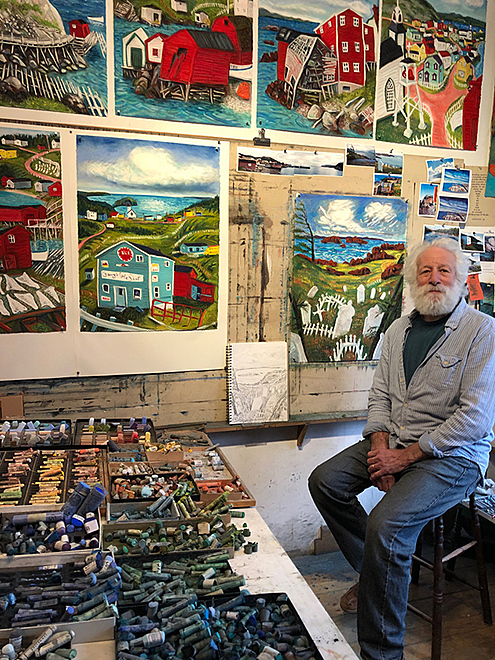
I divide my time working on paintings in pastel and designing and hand printing limited edition books illustrated with my own wood engravings. My press is called the Church Street Press
In the first image I am sitting in front of my easel wall, there are finished pastels on paper tacked to the wall and part of a table full of chalk pastels can be seen off to the side.This series of pastels is based on my on-site sketches in rural Newfoundland on the Bonavista Peninsula where I have a house and studio in an old fishing harbour, near the town of Trinity, these are part of a larger project, and exhibition to be completed 2022. Next fall I begin on a hand printed book of poems by Newfoundland poet, and musician Des Walsh, I will be creating a wood engraving inspired by the poems and my on-site sketches for each of the 16 poems, the pages will be hand bound into hardcovers in a limited edition of 60 copies. The exhibit will feature the paintings, sketches, prints and book, at the English Harbour Arts Centre, Newfoundland.
The second photo shows me standing at the press, a 1940’s Vandercook #4 proof press, you can also see type drawers behind, and some hand printed broadsides in the background. For each of the books I print I set the type by hand, and then print the sheets one at a time on the press onto handmade paper from St. Armand in Montreal. After all the text is printed, I will engrave the wood blocks and print those directly from the blocks one page a time. This project will take two years from start to finish.
Three artists
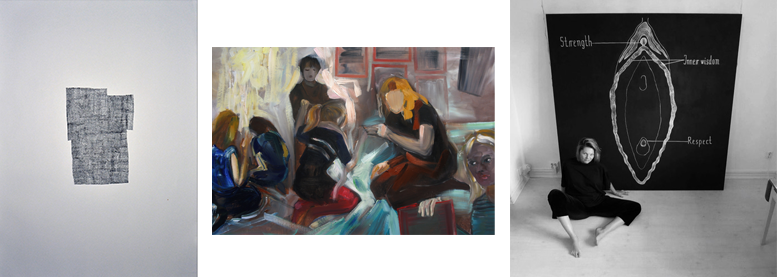
Today’s blogging slots bring you three artists who would soon be showing at Supermarket 2020:
Juanma González (ES) exhibited by AllArtNow (Damascus/Stockholm), the Lithuanian artist and educator Marija Griniuk from Bite Vilnius (nomadic) and Gabriella Novak (PL/SE) performing as part of the Talks and Performance programme. Have a look and read more about their work in the posts below.
Marija Griniuk/Bite Vilnius

Marija.Griniuk, ‘The Nomadic Radical Academy I’, oil on canvas, 2020
I am Marija Griniuk (the artist behind the nomadic project BiteVilnius). My current interest is in exploring oil painting as the media to represent past performances. These paintings are inspired by the stills of video footage from my participatory performance The Nomadic Radical Academy, which was realised in Kaunas, Lithuania in 2019 as a part of BiteVilnius’ activities. The paintings are the subjective observation of the participatory performance, which I facilitate, where the observation is through the prism of me, as the artist behind the idea of performance and me, as a performer.

