Supermarket blog
Thank you all!

We hereby pronounce the Supermarket 2020 Social Media Takeover & Blogging week concluded!
We have to say that the week exceeded our expectations. From what we worried would be a sad week of emptiness and aching hearts of an unfulfilled art fair turned out to be our perhaps most vibrant social media presence ever – and we dare say a great fun not only for us but the contributors and online viewers alike.
We hope that in this simple way we managed to give you a glimpse of what the Supermarket 2020 will be like, with all the creative energy that all the international participants bring to Stockholm. We would like to say thank you to:
A) All of the brave exhibitors who took over our Instagram, Facebook and even Twitter and tirelessly posted round-the-clock. So many wonderful artworks that came up and so many amazing artists that we got to know about. And – above all – we did not get hacked! Videokaffe (FI/DE/NL/UK/USA), Niigata Eya (Niigata, Japan), Extrapool (Nijmegen, Netherlands), Medrar (Cairo, Egypt), Why Quit? (Wroclaw, Poland), Ormston House (Limerick, Ireland) and Detroit Stockholm (Sweden)
B) All of the contributors who sent their materials to the Supermarket 2020 Blog. The variety and amount were heartwarming, your images, texts and reflections full of not only colour and sparkle, but above all stimulating ideas and collaborations.
C) Our online viewers, readers and supporters, including all our exhibitors whom we are looking forward to seeing in early autumn (fingers crossed) for the postponed edition of Supermarket 2020. Your support means a lot to us! You even watched our Live-streamed opening of the cancelled & rescheduled art fair in such copious amounts it took our breath away.
You made our week brighter and fluffier than we could ever dream of.
Take care and keep your eyes on us – the week is over but we are still here and will supply you with regular posts and updates from the artist-run world.
Alice Máselníková, creative director, for the Supermarket team
Marisa Cornejo (CL/FR/CH)/Performance programme
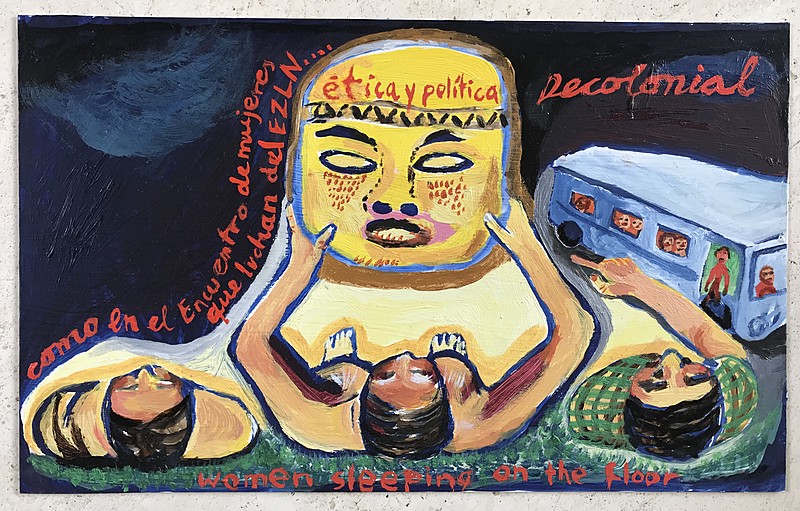
Marisa Cornejo, Dream with Ramon Grosfoguel, oil on metal 25 x 40 cm, 2020
This is a selection of a series of contemporary ex-votos (an ex-voto is a votive offering to a saint or to a divinity) that I painted during the confinement.
These paintings are dreams I had with philosophers that had inspired and supported my artistic practice and research of the last few years.
These ex-votos about my dreams guide my life and give me courage to continue my singular path.

Marisa Cornejo, The skin of shame, oil on metal, 25 x 40 cm, 2020

Marisa Cornejo, Dream with Ramon Grosfoguel, oil on metal 25 x 40 cm, 2020
Marisa Cornejo is an artist based in both Switzerland and France. She has a Bachelors Degree in Visual Arts from the UNAM, Mexico and a Masters Degree from the CCC, HEAD, Geneva, Switzerland. Marisa was born in Santiago de Chile in 1971 and left with her family after the coup d”Etat in 1973, to live in exile in Argentina 1973-76, Bulgaria 1977-78, Belgium 1978-80, Mexico 1980-98 where she studied dance, visual arts and collaborated in the art collective La Panadería in México City. In 1998, she moved to England where she became a mother and 2002 found her in Brussels, Belgium. Since 2005 she is in Geneva where she works with the themes of memory, identity and forced migration through drawing her dreams as an artist researcher.
www.marisacornejo.com
NONSNS/With love from Russia
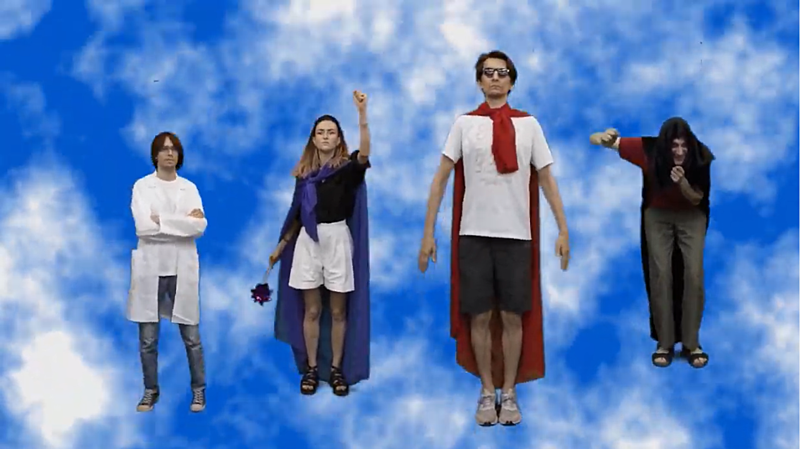
NONSNS (needed ordinary naive speculative new self-organisation) is an independent organisation of three artists: Ruslan Polanin, Masha Cheloyants and Gosha Golitsyn. The NONSNS art group is based in a studio on the territory of the former NIIDAR factory and represents the Moscow art underground as an artistic environment and a live process in which new ways of developing modern conceptual art are thought up and born.
Artists from NONSNS work with various mediums and reassemble their group identities by using of mass culture patterns but always finding ways for their activities outside the mainstream of the art industry. Their artworks which are often absurd and not always recognized as art usually are included into everyday life.

Official NONSNS TV channel:
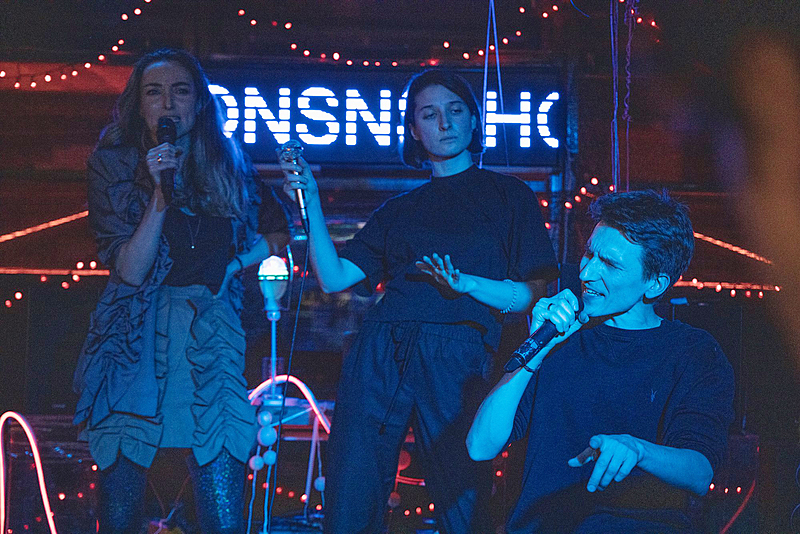
All images courtesy of NONSNS.
Anna Ekros: 24 hours of reflection preparing to write a paper on photography and cyborgs

Photograph of a painting of Anna Ekros (in progress) by Pontus Raud, oil pastel on paper, 2019
9.45 AM In my studio by the desk reading notes from classes I took in 2015, desperately looking for inspiration. It seems as if I didn't absorb what I noted down. I’m constantly surprised. “The potency of all means toward emancipation is dependent on time,” I read. “Provocation poking fabrication tends to get swallowed and labelled turning into calculated rudeness, behaviors already accounted for.” Scribbled in the margins in handwriting that is even less legible I read “Improvisation can no longer be punk. Even if Lydia Lunch claims her right to wear the same clothes she did 30 years ago no one is looking her way twice. Modernism and postmodernism, punks, hippies and jazz saxophonists had their moments, sometimes successfully conveying a truth twining about a gesture like ivy around a wall. But when the gesture has become obsolete, the truth is unable to communicate. A potent ride is needed for its translation.” I close the notebook. Who’s that antifeminist 22 year old hating on jazz?
10.45 My younger sister is coming by for lunch. She decides to help me unclutter my Instagram account. I catch myself being sentimental. I truly believe that what I think is the real me will appear virtually through my content. She is ruthless. I’m like DON’T delete that pic. That's Felix; the cat, remember? And she’s like what's your problem, is it a photo or the actual pet cat? I’m thinking to myself that I sort of lost the understanding of the difference. The last step in becoming a cyborg is complete.
Felix the housecat, photo by Anna Ekros 2006
1 PM My sister says bye and I turn around in my armchair and open a book from the pile on my desk. On the second page of In Plato's Cave Susan Sontag is making a differentiation between photography and other kinds of representation. Written statements, drawings and paintings she defines as interpretations of the world. Photographs on the other hand “seem to be a piece of the world.” On the same page Sontag defines photographs as being “perhaps the most mythical of all objects that make up, and thicken, the environment we recognize as modern.”
3 PM What is the difference between what something is and what something seems to be? And what is the difference between magic and myth? A quick google search points me toward myth being a network of stories where the origin of the stories is unknown and magic has more to do with craft. I recall that in the first book of Hauser’s A Social History of Art he explains that, from the very beginning, art was pure magic. The mythological feature of art appeared later, with the photograph.
3.15 PM I look at pictures of Benjamin wearing Kafka's hat in Silverman’s The Miracle of Analogy and realise that I am not ready to write anything on this topic. Why didn’t I choose to write something on Giotto instead.
3.30 PM I open my laptop and type “I don’t see the difference between real and fabricated. My mind turns photographs into cats.” What I don’t realise is that the photograph led me to see the inner workings of my perception. I keep thinking about the difference between magic and myth. A magician one can debunk by sneaking in behind the theatre curtain. But myth is harder to punctuate due to absence of logical order to examine. Even if I don’t believe in the stories, they still seem true and it doesn't hurt to avoid placing my keys on the table. How to claim back my perception from the screen and reality from my keychain?”
5 PM I desperately go through notes from some old English Literature class to find inspiration. “Auerbach when writing about Virginia Woolf’s To the Lighthouse is pointing out that throughout the novel, occurrences are only accounted for by what the occasion releases within the characters,” I read from my own scribbles. “To these characters objects are not as important as feelings.” That’s exactly the way I navigate the world, I think to myself. Feelings caused by a cat or a photograph are the same therefore the objects are exchangeable. I turn to my laptop “The emancipatory gesture of modernism was to break out of fabricated figurative illusion by examining the material of which things consisted, in the case of Woolf, material being perception itself. What figurative illusion, beyond social norms and identity, is there to break out of today? Is there a way to ask that question without being cynical?
6 PM. I call my friend the dancer to ask her something about choreography. She says choreography is abusive by default. Like composition? I ask. I know nothing about music, she responds. I hear the interior mechanical movements of the clock in the other room. Tick tock tick tock. Ok thanks. I hang up.

Profile picture from social media, photo by Anna Ekros 2019
7.30 PM. In front of another desk, this one at home. I scroll through notes on my laptop. In the art history folder I find one named PHOTOGRAPHY_BACON. I think to myself as I open the document that my categorisation skills are horrific. The note is for my friend Miriam relating to a conversation about one of her poems. I read “Francis Bacon, in that book The Brutality of Facts, where he is interviewed by David Sylvester, speaks of how he uses photographs when he is painting. Bacon is pointing out the skewed perspective that the lenses in a camera almost inevitably create. He is trying to catch the perspective through painting. The skewed perspective caused by the poorly optimized lenses is one that the eye on its own is correcting and unconsciously we bridge the logical gap of the photograph. Asking us to kindly compensate for the logical absences, the photograph will not reveal the way in which it creates illusion. I recall that Bacon saw this as violence against the human mind.” I close the document. In some way then, I’m thinking, staring out the window; photography, just like myth, performs violence on its readers. But is this asymmetrical relationship between the photograph and the viewer inevitable?
9 PM I open an empty document and begin typing. “Through using photographs as models for paintings Bacon was creating a figuration of a mythological abstraction, pointing out what is truly there. This to continue the dialectical movement between abstraction and figuration and not allow one abstraction to dominate the representation of human perception.” I look out the window. The neighbor is walking his small white dog. They cross the street and disappear behind a few trees. I type “While montages of algorithms piled upon one another build a thicker veil, the progress of Silverman’s photograph is unstoppable unless we decide it isn’t.” I look outside again. There are five trees, the low branches move with the evening breeze. “Do I really have to ask myself if the truth exists? Finding the right gesture, I suppose the question, not the gesture, would be rendered obsolete.” I close the laptop and leave the room.
03.30 AM A song filled to the brink with joy and desire is heard through the bedroom window. Can you hear the blackbird I say and my lover laughs his head off. You sound like the lamest person in a romcom he says and asks me to shut up. I’m thinking of why he’s relating everything beautiful (or, to him, abnormal) to movies. OMG she was so hot, and came up to me, like in a movie. OMG the guy tried to take my watch, it was like in a movie.
9 AM While driving, I ask the compound of algorithms that translate words into writing in my phone to text my sister “You were right, my Instagram account is not me, it just seems to be, and the realisation that I don’t know the difference is what protects me from being a cyborg, right?” Felix is not on my screen. He is in a box being eaten by worms. The blackbird outside my window this morning was very much alive though. Getting rid of reality I would lose both cats and birds, and that's a price I am not willing to pay, you get me?
9.02 She replies “Anna, it's 9 in the morning on a Saturday shut the fuck up.”
9.03 I respond 😘
I'm Happier Now, A video of my sister miming with a filter over her face by Lovisa Garner 2019
Anna Ekros (born 1988) is a visual artist, writer and art historian specialised in photography. She holds an MFA from International Center of Photography/Bard College and an MA in Critical Theory and the Arts from the School of Visual Arts in New York City. Ekros was educated by masters such as Anders Petersen, Halil Koyutürk and later Nan Goldin. She has an interest in truth in relation to imagery, curious of the moments where the edges of the medium become visible. As a part of the Supermarket team she works as photography and education coordinator.
tm•galleria, Helsinki, Finland
At Supermarket 2020 tm•gallery exhibits four contemporary painters:
Matilda Enegren (b. 1989 in Vaasa, lives in Helsinki)
Kaija Hinkula (b. 1984 in Oulu, lives in Oulu and in Helsinki)
Arto Korhonen (b. 1963 in Rantasalmi, lives in Helsinki
Joel Slotte (b. 1987 in Kokkola, lives in Helsinki)
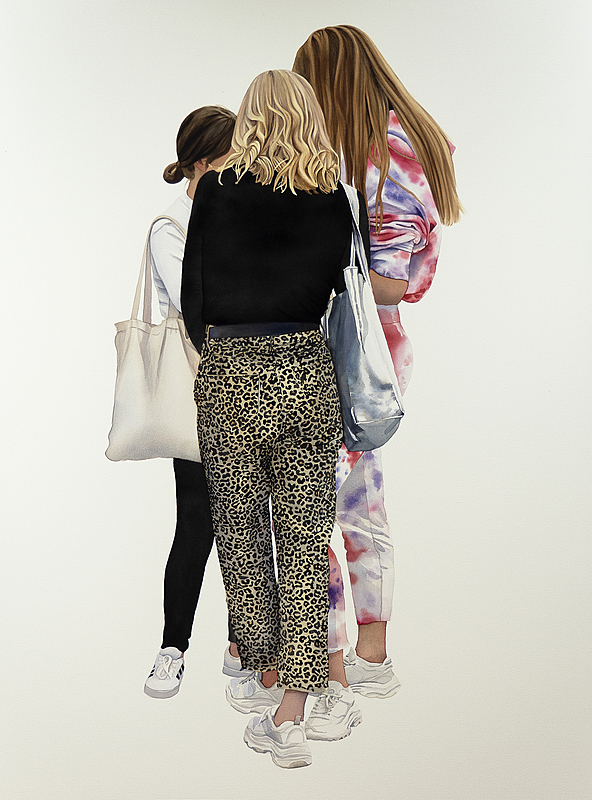
Matilda Enegren, ‘Storgatan’, watercolour on paper, 154 x 116 cm, 2019
Matilda Enegren arbetar med figurativt måleri och målar porträtt av sig själv och andra, detaljer ur urbana miljöer och bortvända ungdomar i grupp. Målningarna är utsnitt ur tillvaron, sådant hon fastnat för och vill avbilda genom ihållande observation.
https://www.matildaenegren.com/

Kaija Hinkula, ‘Cube 3’, oil and spray paint on plexiglass, 70 x 50 cm, 2019
Kaija Hinkula is inspired by the process of the painting – the physical appearance and movement-like metamorphosis of paint on the surface of a sheet. Her aim is to build abstract slow motion reflecting on existence while highlighting the paint matter and the painting event. Her works are associated to materiality, movement and circulation, the technic is oil on different materials and installation.
https://kaijahinkula.com/

Arto Korhonen, ‘Caps’, watercolour on paper, 2017, photo: Anna Autio
Arto Korhonen combines in an innovative way traditional watercolor painting with ordinary, daily urban imagery and makes it available to a wider audience. He says: I want to use watercolor, and build installations that show, that crafts based on old technology, make the contemporary phenomena visible in an interesting way.
http://www.artokorhonen.com/
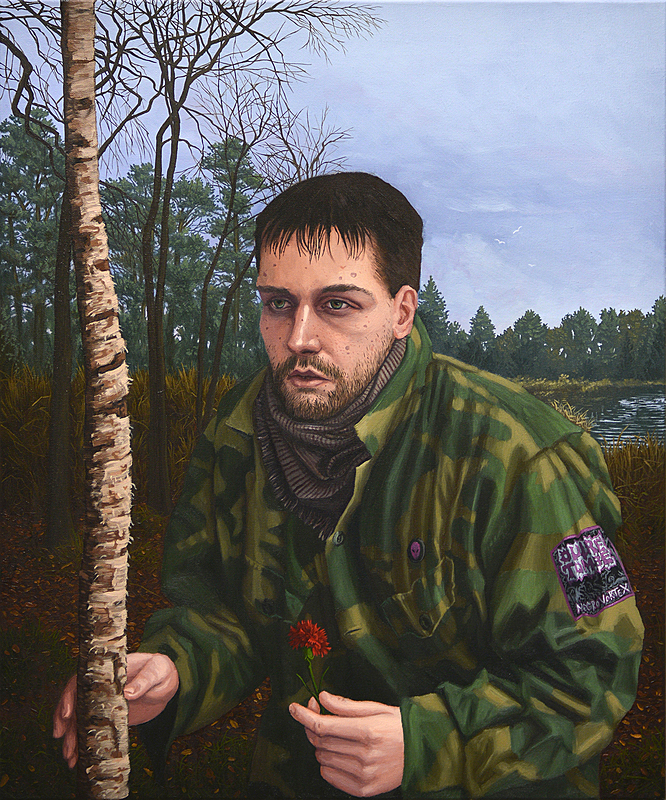
Joel Slotte, 'Lovesick man and a carnation', oil on canvas, 73 cm x 61 cm, 2020
Joel Slotte is a Helsinki-based artist working in oil painting, drawing and ceramics. His work explores traditions within image-making, indiscriminate sensuality and the aesthetisizing of anecdotes from everyday life.
http://www.joelslotte.com/
tm•galleria, located in the center of Helsinki, has a versatile profile focusing on new Finnish painting. The gallery is managed by Finnish Painters’ Union, which is a nationwide artists’ association, and with about 1300 members the biggest artists’ association in Finland. The association also organises exhibitions in collaboration with art museums and other institutions. Every year in March the association organises The Sales Event at Cable Factory, Helsinki. During the event, almost 1700 works by about 600 artists from all over Finland are on display.
https://www.painters.fi/tmgalleria/