Supermarket blog
Nieuwe Vide Radio: Podcast Episode 2 with Verena Hahn as a guest
Nieuwe Vide from Haarlem, Netherlands, bring you today the Episode 2 of their podcast of Nieuwe Vide Radio with artist Verena Hahn as a guest.
Verena Hahn's film We'll Have Time For That Later will be made available online at Nieuwe Vide's website on 27th April, 12.00.
Due to the Corona pandemic this year’s edition of Supermarket Art Fair has been postponed. Because Nieuwe Vide cannot present there at the moment we will share with you an online preview of the work we were going to show here. We’ll Have Time For That Later by Verena Hahn is an artistic documentary that explores the world experience and agency of preppers. Prepping is a practice in which so called preppers prepare to live a life that is non-depending on external parties, such as electricity suppliers, the police, food suppliers or a community. In the center of prepping stands the anticipation of a crisis that needs a long-term preparation. In Hahn’s work, prepping is not understood as a mere hobby, but as a specific agency of the time we live in. The film traces the connection between the storytelling in prepping and real contemporary conditions that influence and determine these world descriptions. The film reflects in a subtle but critical manner on the role of the filmmaker and the complexity of documenting certain ideologies.

Nieuwe Vide is an exhibition and project space and has 27 studios where artists and creatives work. We provide young artists with a space to experiment and give them tools to professionalise their practice. Our programme of exhibitions, workshops, talks and presentations is inspired by popular culture, new media and politics. True to our squatters roots of 25 years ago we operate on a community level and offer a programme of educational and social activities.
Pontus Raud

Pontus Raud, ‘The last Moon’, engraving and gouache on paper, 2020
A game changer - a small organism is changing the whole world in just over six weeks. Everyone is surprised at how fast it went and how quickly we changed our behavior. We have been so busy with the digital revolution and all the technological advancements that are moving us forward with a greater speed that we overlooked the whole biological mechanism that is actually constantly moving us forward.
The old saying - Of children and fools you know the truth - appeared in my head in a reworked version in a conversation with my son when he was eight years old. He snapped a question out of the blue…
-
Dad, when does the brain work the most, day or night?
I respond quickly with a logical answer in my opinion - I would say in daytime because you have to make so many choices all the time. You should brush your teeth (clever fatherly choice of event), eat breakfast and then walk to work… then it is just full of choices of all kinds, all day. That's right huh?
-
It’s totally wrong! At night, says the child with great enthusiasm, the brain must invent rainbows, unicorns and flying saucers in order to clear its head ... that's when it works the most ... to cleanse the head!
Later, I lie in the dark, in my bed and wonder if it might be true ... could the brain work more at night than during the day?
Typically, I end up in front of the computer and start hitting the subject. I read about the so-called clock genes, which are found in virtually all cells in almost every kind of organism. In all mammals, this internal clock consists of nerve cells in a diffusely delimited small area in the anterior part of the brain. In Latin, the area is called nucleus suprachiasmaticus (NSC), which is defined as "a nucleus, located above the optic nerve intersection (chiasma)". NSC acts as a chief conductor for the entire body: its signals determine how active different organs should be.
After searching a number of different pages, it seems that measurements of the brain's activity reveal that those parts of the brain that have a connection to feelings and the preservation of memory impressions are more active during sleep than in waking state.
- Of children and fools, I think before I go for an intense sleep!
Michael Hamony
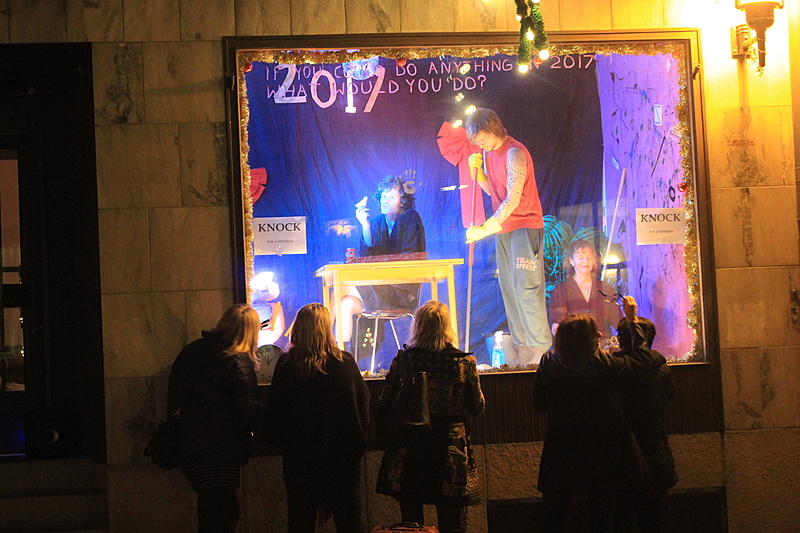
The pictures are taken from a performance art piece from 2016/2017. I was assigned to create some kind of art or performance art in a shop-window in central Gnesta (Sweden). I was one of several artists that each got one week each with this shop-window at their disposal. The only rule was that it had to interact with the people passing by. I named my piece ‘TIME, HOPE & DREAMS’ and the idea was to present different themes each day. Every night for 30 minutes I had actors in the window doing certain theme-related activities. Any time the audience outside knocked the actors freezed for 10 seconds and then proceeded as normal. It was fun and the project was much appreciated.

Corona Notebooks: Adi Argov, Nubolaz Cooperative Art Space, Tel Aviv, Israel
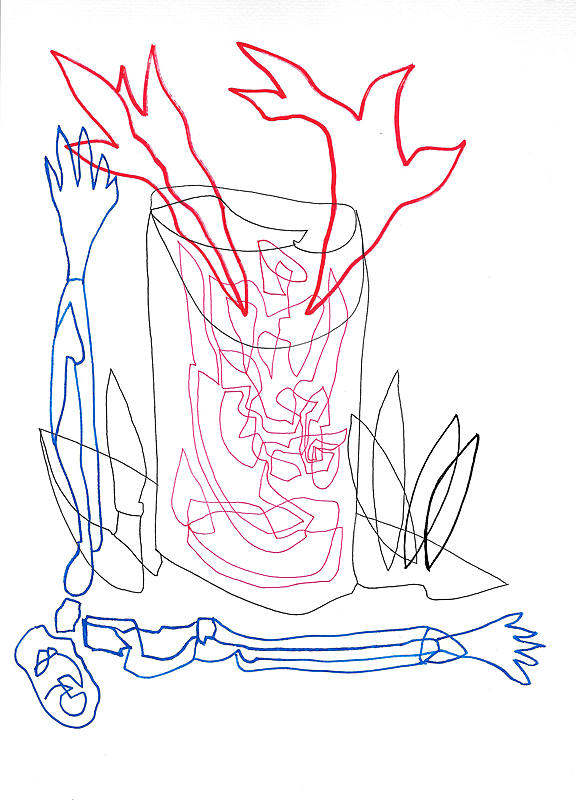
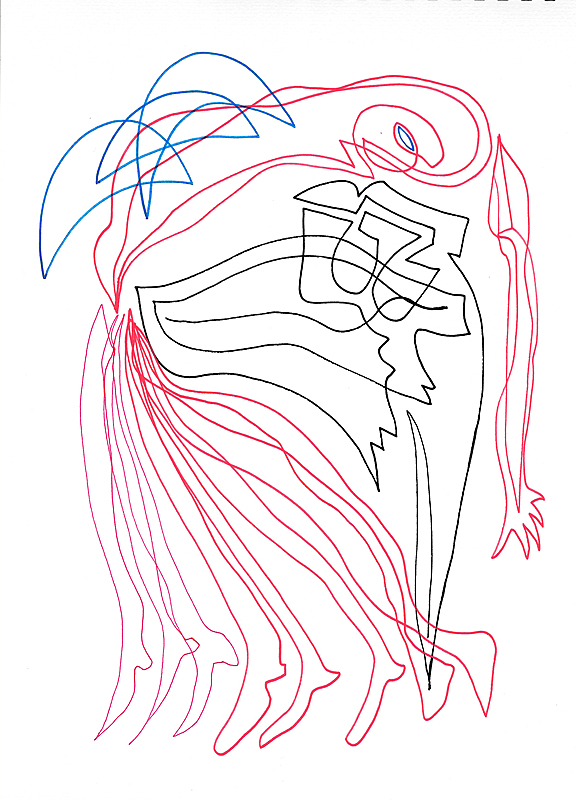
Adi Argov, No Running: corona notebooks, 2020
Artist Merav Shinn Ben-Alon interviews Adi Argov, artist from Nulobaz cooperative space Tel Aviv on her artistic activities during quarantine.
Who are you? Adi argov, multidisciplinary artist, Bezalel BFA graduate 2009, Art teacher and freelance editor and translator. Founding member of the artist-run gallery Nulobaz cooperative space. Living and working in Tel Aviv, Israel. Right now quarantined at home and working mainly from my living room.
How are you? I’m great. Surprisingly this weird time calms me and allows me to rest and focus on what's important to me: cooking, gardening, exercise, drawing and writing. Also, sometimes doing nothing is important.
What is the name of your project? ’Corona notebooks’
When did you create this project? Over the last month.
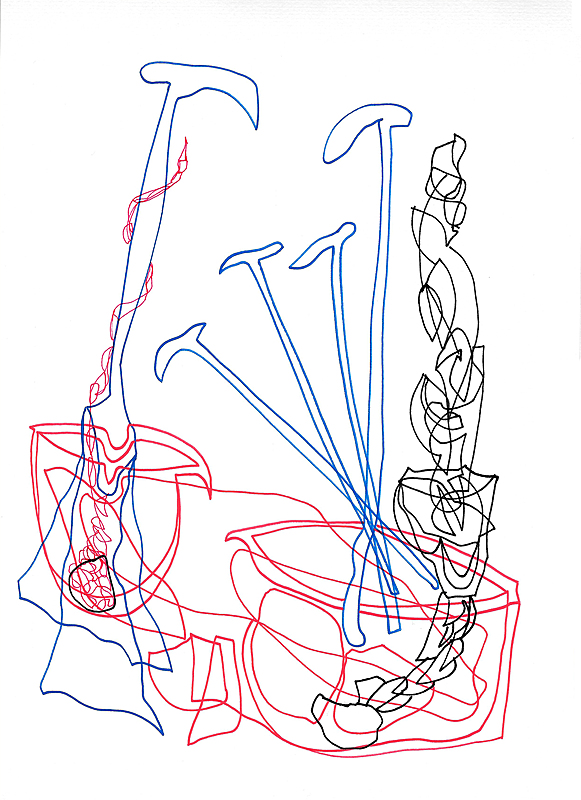
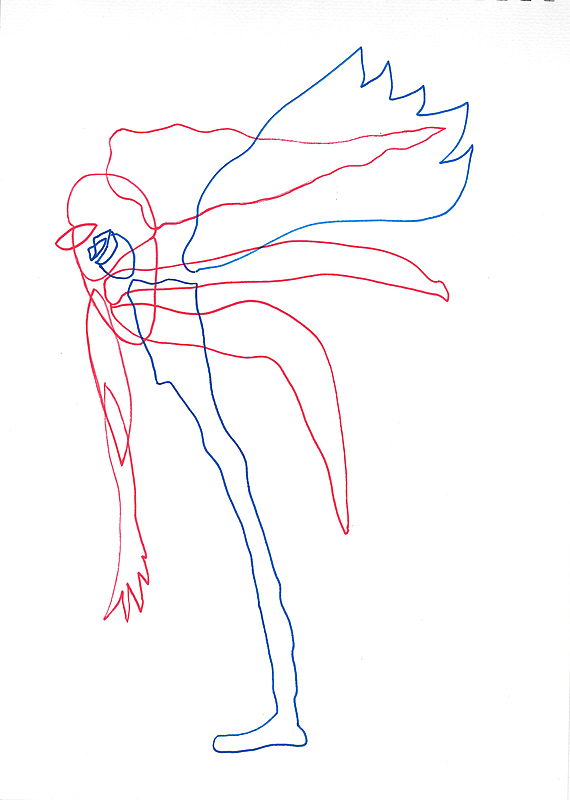
How did you create this project? With what mediums did you work? For many years now I've been drawing in notebooks alongside my work in the studio, in which I focus on drawing, painting and installation. The notebooks are a good way for me to start working and get things moving. It is good practice for the head and the hand. I found that it sharpens my thoughts and clarifies things that occupy my mind. It is a journal that accompanies me and echoes the style, temperament and mindset of that time. Now, when I'm closed in at home and unable to go to work in the studio, I rediscovered that the most natural thing for me is to focus the process through drawing. So once quarantine commenced, I started a new notebook.
Why did you choose this medium, this technique for this project? Drawing in a notebook is for me an immediate or even primal action that allows me to express feelings and ideas without mediation. Working with felt-tip pens and limited color choices helps me focus in a very open and free action and generates a set of limitations within which I can create.
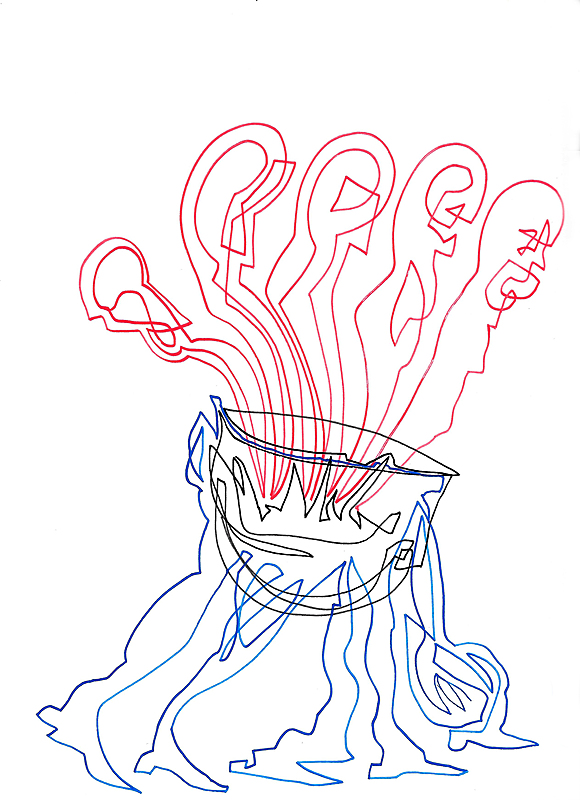
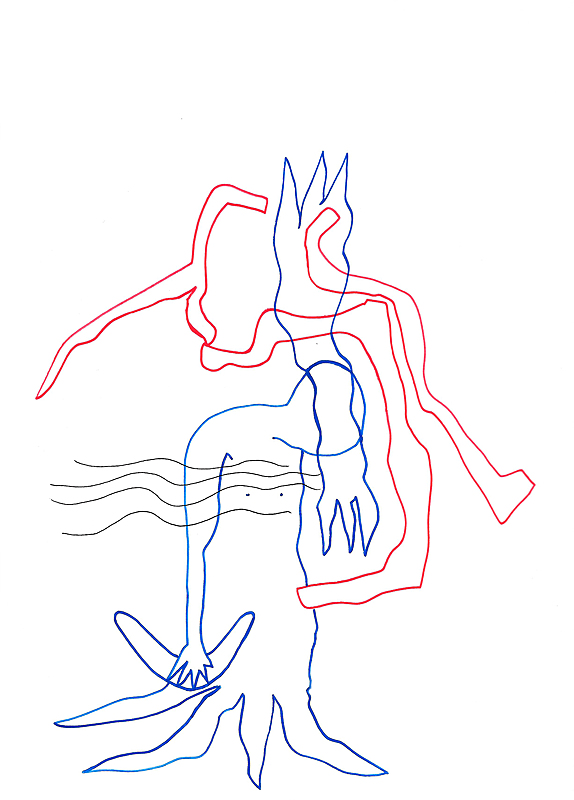
What is the subject of your research? The subject of my research is language itself. I seek external inspiration but I do not look at the external while working. Usually there are a number of images that engage me and I create variations of them within the works. I aspire to reach a state in which the image is in between a clear representation and abstract.
Tell me about the process. How did you get started on the project and how did it develop? Like many artists, I've always held a sketchbook. At first, the notebook contained a mix of sketches, ideas, drawings, experiments and writings. Over the years, the notebooks have been split into different uses, a separate notebook for writing, sketches of works and sculptures and notebooks dedicated solely to the drawings where I can practice and develop my drawing style.
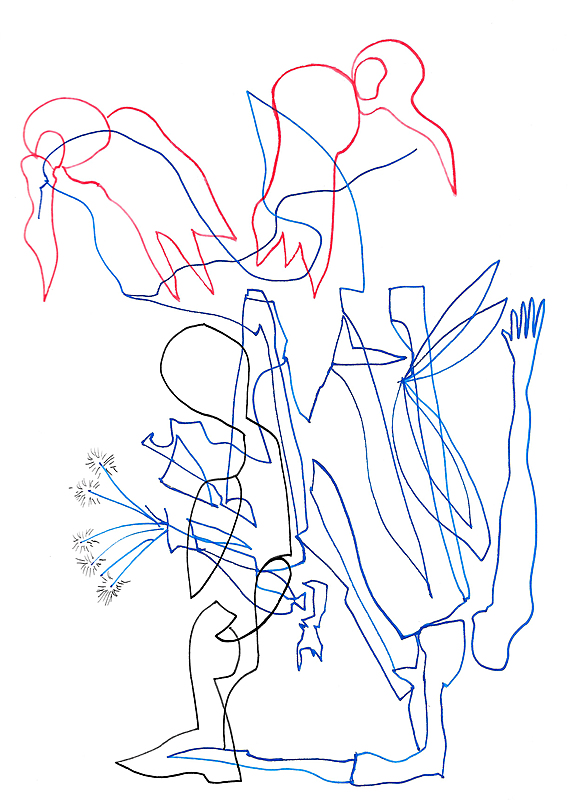
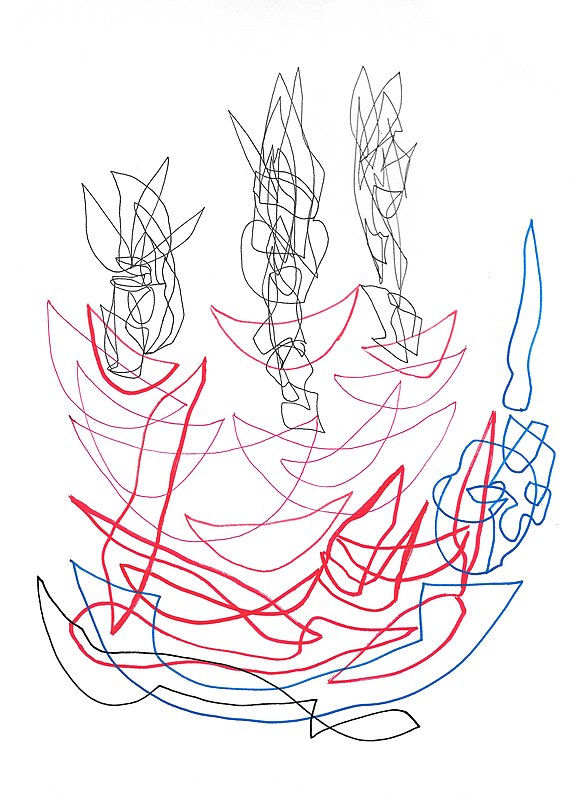
Was there a source of inspiration for the project? Recently I've been looking at the works of Julie Mehretu, an American artist who creates large-scale abstract drawings.
What is the story that the works tell? The drawings describe small and minor situations from several perspectives, sometimes as a disassembled story. It is a visual experience that leaves room for the subjective eye. At first, this can be challenging for the viewer, but when you surrender the need to interpret something else is revealed.
Nulobaz Cooperative Art Space members reflect through different perspectives on the pain and sacrifices of living in a complex and violent reality, the result of the ongoing Israeli Palestinian dispute. Through their personal experience as Israeli individuals and artists, who grew up amidst the conflict, they sense a gap between the ethos they have absorbed since childhood through education and military service, and the reality that they actually see. This gap between the narrative and individual experience is where they focus their art.
Kunstverein Famile Montez, Frankfurt, Germany

Daily K&K (Kaffee & Küchen) in Montez cafe by Ilka Hendriks
The Kunstverein Familie Montez directs the your focus to ...
Montez: New Generation 2020 with a new project named Montez 2.
In 2019 the Kunstverein Familie Montez expanded with a new space – a newly acquired independent Atelier/Studio space situated in a neighbouring building in the Osthafen called the Kulturbunker.
It’s in the immediate vicinity of the Honsellbrücke (KVFM).
Montez 2 is a project space for young adults, developing experimental printing techniques producing screen prints onto textiles and repurposed clothing.
The focus here is primarily on the individuality of the individual print.
There is little emphasis on uniformity, differences within a print run are intended and welcome.
Subjects are repeatedly printed, overlapped and placed in different positions.
The final products are expected to be presented/exhibited in the form of a fashion show.
Montez 2 design merchandise for a fabricated museums shop at Supermarket Art Fair 2020. We will present the design studio work of Montez 2, in the form of a Living Atelier, with photo shoots, videos, live workshops, streaming and a fashion show performance throughout the fair.
For Montez Werkstatt: Oscar Zickler, Anton Zickler & Ali Kaan Aktürk.
In addition to the t-shirt designs KVFM will feature a series of editions: silk screen prints by Kerstin Lichtblau, photography and merchandise by TO KUEHNE, and photography and stitched texts onto canvas by Elizabeth Coleman-Link. Daily K&K (Kaffee & Küchen) in Montez cafe by Ilka Hendriks.
Prints by Kerstin Lichtblau ...

Daily K&K by Ilka Hendriks ...
We present TO KUEHNE ...

Born 1967. More than 20 years of artistic experience in the areas of painting, photography and music. Many various solo and collective exhibitions in galleries, art houses, bars, offices, fairs, etc. Came to photography via painting.
His approach to a picture differs to that from a classically trained photographer.
“I don’t take photographs, but paintings.” His pictures, mostly staged and often heavily reworked, are influenced by his 20-years’ experience with Rock ‘N’ Roll, theatre and film as well as advertising productions. Many of the protagonists in his pictures seem to have come straight from a film or commercial. Another recurring feature is the lean towards classic themes in his work, like scenes from religion and art history. For years now, he has worked on his self-dramatisation project ‘The Art of Loving Yourself’, with which he tours a travelling exhibition. Not unlike a rock tour.
Another focus of his work is his self-staging image series ‘Aurora To-Realis’, his tribute to Mexican lucha libre ‘Elverdadero Santo’ and his interpretation of religious icons.
Kunstverein Familie Montez e. V. is an official art association/artspace/collective which exhibits contemporary independent art, based at the Honsellbrücke (KVFM) Osthafen, Frankfurt am Main, Germany.